
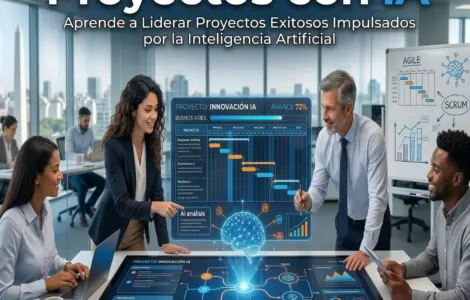

About This Course
The Course Professional Project Management with Agile Methodologies and Artificial Intelligence is aimed at people who want to acquire skills to plan, organize, and execute projects efficiently in professional, business, or institutional environments.
Throughout the training, internationally used knowledge and tools in project management are developed, allowing the structuring of objectives, coordination of work teams, management of resources, and control of results.
The training combines theoretical foundations with practical applications, also incorporating the use of digital tools and artificial intelligence resources that improve planning, decision-making, and project monitoring.
The program is designed so that participants can apply the acquired knowledge in organizations, companies, ventures, or personal projects.
Purpose
The objective of the course is to train professionals capable of designing, planning, executing, and controlling projects in a structured and efficient manner, using recognized management methodologies and modern work tools.
During the training, participants will learn to transform ideas and objectives into concrete projects, developing the ability to define scope, organize tasks, manage resources, identify risks, and lead work teams.
The course aims for each student to be able to apply the acquired knowledge to improve project organization, optimize work processes, and increase the likelihood of success in professional or institutional initiatives.
Certification issued by ACAFOR, endorsed by AMUPEF, Asociación Mutual del Personal de las Fuerzas.
Course Contents
Module I: Fundamentals of project management
Concept of project, differences between projects and operations, role of the project manager, project life cycle, and main international management standards such as PMI, PRINCE2, and agile methodologies.
Module II: Project initiation
Identification of opportunities, definition of objectives, scope delimitation, stakeholder analysis, and preparation of the Project Charter as the project's initial document.
Module III: Project planning
Development of the work breakdown structure (WBS), task planning, Gantt charts, critical path, resource planning, and organization of project activities.
Module IV: Time management
Estimation of task durations, activity sequencing, creation of the project schedule, and control of adherence to established deadlines.
Module V: Cost management and budgeting
Estimation of project costs, budget preparation, financial tracking, and variance analysis during project execution.
Module VI: Risk management
Identification of potential risks, qualitative and quantitative analysis, development of mitigation plans, and contingency management.
Module VII: Team management
Formation of work teams, project leadership, organizational communication, and conflict resolution within the project environment.
Module VIII: Agile methodologies
Principles of the Agile approach, introduction to Scrum and Kanban, organizing work in sprints, backlog management, and adapting projects to dynamic environments.
Module IX: Project control and monitoring
Performance indicators, progress reports, change control, evaluation of project progress, and monitoring tools.
Module X: Digital tools for project management
Use of platforms such as Trello, Asana, ClickUp, Notion, and MS Project to organize tasks, coordinate teams, and manage projects efficiently.
Module XI: Artificial intelligence applied to project management
Use of artificial intelligence tools for planning, schedule generation, risk analysis, report preparation, and decision-making support.
Module XII: Practical case studies in project management
Analysis of real projects in different areas, including technology implementation, product launches, and organizational projects.
Learning Objectives
Requirements
- No prior knowledge of project management is required
- It is recommended to have a computer or device with internet access
- Willingness to apply the concepts in practical exercises
- Interest in improving the planning and organization of professional projects
Target Audience
- Professionals who participate in or wish to participate in projects within organizations
- Entrepreneurs who need to plan and execute business initiatives
- Managers responsible for teams or departments that manage projects
- Consultants and professionals who work with strategic planning
- People interested in acquiring project management skills
Curriculum
Introduction to project management
What is a project?
Project definition
Formal definition of a project
Real project examples
Difference between project and operation
Operational processes vs projects
Business examples
Role of the Project Manager
Responsibilities of the Project Manager
Key competencies
Technical and leadership skills
Project life cycle
Project initiation
Project planning
Project execution
Project monitoring
Project closure
International standards
PMI
PRINCE2
Agile
Project initiation
Project planning
Time management
Cost management
Risk management
Risk management
Get your certificate!
Upon completion of this course, you will have access to an international certificate that will endorse your knowledge.
Your Instructors

 Spanish
  English
  Portuguese